Dollar-Cost Averaging and Average Stock Cost: Invest with a Plan, Not Emotion
In Brief
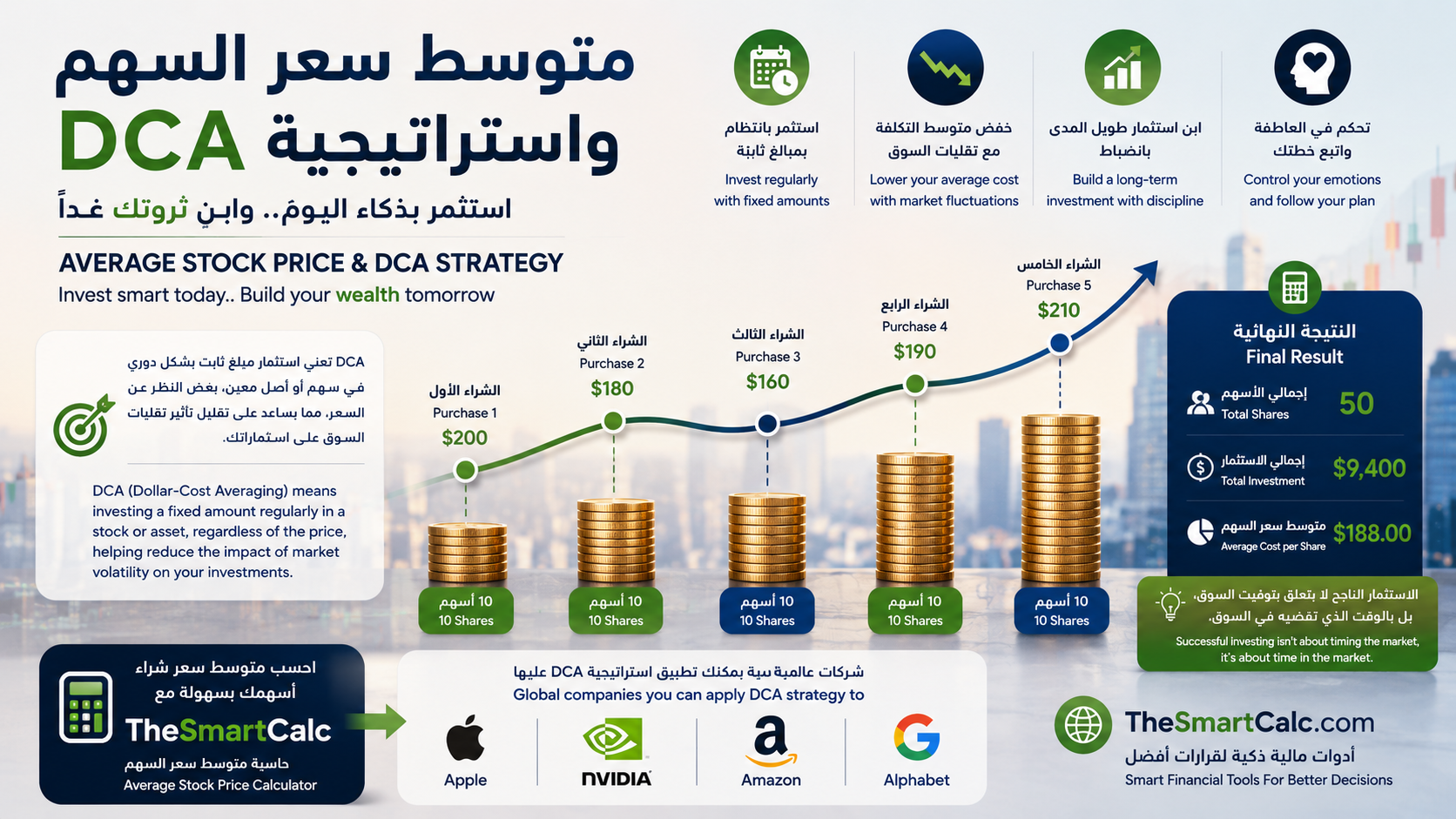
DCA means investing equal amounts at regular intervals regardless of market fluctuations. An average cost calculator solves a related but different problem: after buying shares at different prices and quantities, it tells you the weighted average price you actually paid.
Why Investors Chase Price Instead of Value
When a popular stock rises quickly, investors may feel pressure to buy before they miss out. When it falls, fear can take over. Repeatedly timing short-term market moves is difficult, which is why some long-term investors use systematic purchasing plans to reduce reliance on a single entry point.
What Is Dollar-Cost Averaging (DCA)?
Dollar-cost averaging is an investment approach in which you invest equal amounts of money at regular intervals regardless of whether prices are rising or falling. The same dollar amount buys more shares when prices are lower and fewer shares when prices are higher. DCA does not guarantee a profit or a low average price; its main purpose is to create a consistent process rather than depend on one market-timing decision.
DCA Is Not the Same as Averaging Down a Losing Stock
DCA is a predetermined schedule, such as investing a fixed amount every month. Buying more shares only because a stock has fallen in an attempt to lower your average cost is not necessarily DCA. A lower price alone does not make a company a better investment. The investment thesis, valuation, risk, and portfolio concentration still matter.
Educational Example: Apple and Buying More Shares at Lower Prices
Assume an investor allocates $600 to Apple each month for three months. At a hypothetical price of $200, the investor buys 3 shares. At $150, the same $600 buys 4 shares. At $120, it buys 5 shares. The investor purchased more shares when the hypothetical price was lower without needing to predict the exact bottom. These figures are illustrative only and are not historical prices or investment recommendations.
Educational Example: NVIDIA and the Reality of Volatility
NVIDIA has attracted substantial investor attention because of growth in computing and artificial intelligence. But a strong business narrative does not mean a stock price moves in one direction. A systematic investor may spread purchases over time rather than commit all available capital at one price. DCA still cannot protect against losses if the investment declines over the long term.
Amazon and Alphabet: Think Like an Owner, Not a Price Chaser
The same principle can be applied when researching companies such as Amazon or Alphabet. A long-term investor should not assume every decline is automatically an opportunity. Ask whether the business has changed, whether the original investment thesis still holds, and whether the position remains appropriate for the portfolio.
What Is Average Stock Cost?
If you buy the same stock multiple times, simply averaging the quoted purchase prices can be wrong when the quantities differ. Your true average purchase price is weighted by the number of shares purchased at each price.
How to Use TheSmartCalc Average Cost Calculator
Enter the price and number of shares for each purchase. Add every transaction you want included. The calculator can then show your total shares, total invested amount, and weighted average purchase cost. This gives you a clearer view of your position, but it does not tell you whether a stock should be bought or sold.
Example with Different Share Quantities
Suppose you buy 5 shares at $100 and later buy 10 shares at $80. Your average cost is not simply $90, because you purchased twice as many shares at the second price. TheSmartCalc Average Cost Calculator accounts for the actual quantities and calculates the correct weighted average automatically.
When Can DCA Be Useful?
DCA may suit investors who invest part of their income regularly, want to reduce emotional decision-making, or prefer to spread market entry across multiple dates. It does not eliminate market risk, and it can underperform investing an available lump sum immediately when markets rise after the initial date.
Common Mistakes When Averaging Down
Do not treat every price decline as a reason to buy more. Other mistakes include allowing one stock to become too large a portion of the portfolio, ignoring deterioration in the underlying business, investing money needed in the near term, and treating your average purchase price as the stock fair value.
Your Purchase Price Is Not the Company's Value
A stock can trade below your average cost and still be expensive based on its fundamentals. It can also trade above your average cost while the business remains attractive under an investor's analysis. Average cost describes your position; it does not determine the company's intrinsic or fair value.
Use the Calculator as a Measurement Tool, Not a Buy Signal
TheSmartCalc Average Cost Calculator does not predict future prices or identify the best time to buy. It organizes your numbers by showing your weighted average cost, total shares, and total capital invested. Investment decisions still require consideration of business quality, valuation, diversification, risk, and personal financial goals.
Frequently Asked Questions
Does DCA guarantee a profit?
No. Investing at regular intervals does not remove market risk or guarantee that an investment will increase in value.
Can DCA be used with individual stocks?
Yes, but individual stocks carry company-specific risk. Investors should evaluate the business and portfolio concentration before increasing a position.
Does buying below my current average always reduce my average cost?
Buying additional shares below your existing weighted average will generally reduce the average purchase cost, but that does not make the investment decision automatically sound.
Is average purchase price the same as break-even price?
Not necessarily. Commissions, fees, taxes, dividends, and other factors can affect the actual break-even point.
Can I calculate several stock purchases?
Yes. Enter each purchase price and share quantity to calculate a weighted average based on your actual transactions.
Final Thoughts
The strength of DCA is not its ability to predict markets; it is the discipline of following a consistent plan. When you buy a stock more than once, TheSmartCalc Average Cost Calculator helps you understand the weighted price you actually paid. Use average cost to measure your position, not as a standalone reason to buy more or hold a stock.
Educational Disclaimer
All company references and prices in this article are provided for educational illustration only. They are not investment recommendations and do not necessarily represent current or historical market prices.
Try the Average Cost Calculator
Calculate your average cost per share using the dollar-cost averaging method.