Your Home Has a Price — But What Will You Actually Pay?
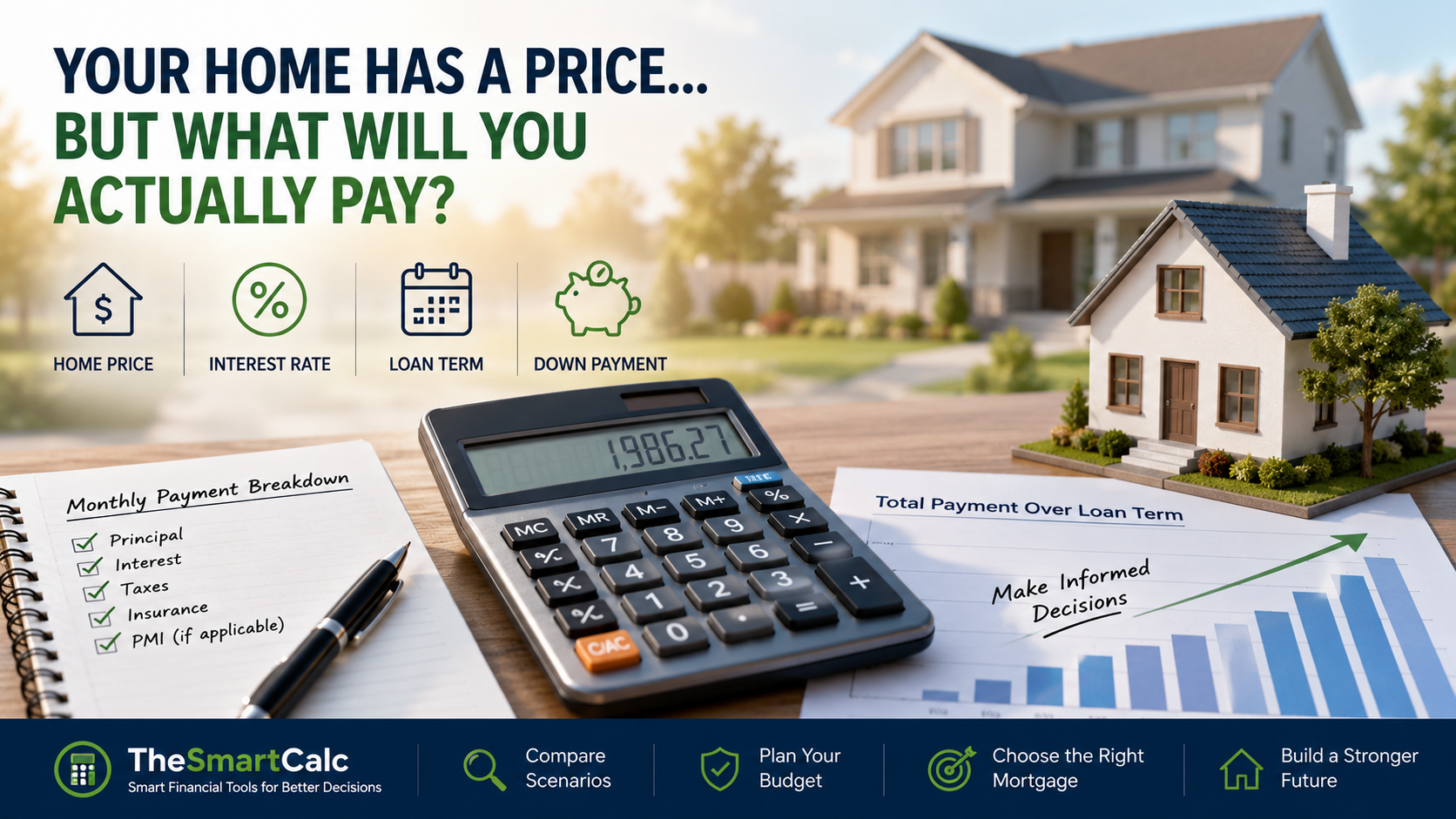
A $400,000 Home
Imagine finding a home you really like for $400,000.
The location works. The property fits your needs. And at first glance, the price seems to fit your budget.
There is just one problem:
You don't have $400,000 in cash.
So you make a down payment and borrow the rest with a mortgage.
That is where the real story begins.
The home may have a $400,000 price tag, but that does not mean $400,000 is all you will eventually pay.
There is the amount you borrow, the interest charged on the mortgage, and the number of years you spend repaying it.
Together, these numbers can make a substantial difference.
The Down Payment Changes the Starting Point
Suppose you make an $80,000 down payment.
That leaves approximately $320,000 to finance.
A larger down payment generally means borrowing less.
A smaller down payment means financing more.
So far, the idea is simple.
But once you know how much you need to borrow, another number becomes extremely important:
the mortgage interest rate.
A Small Difference in Interest Can Mean a Big Difference in Cost
A small change in percentage may not seem important when you are buying something inexpensive.
A mortgage is different.
You may be borrowing hundreds of thousands of dollars and repaying that money over 15, 20, or even 30 years.
That means a difference in the mortgage interest rate can affect:
Your monthly mortgage payment.
The total interest you pay.
The overall cost of the mortgage.
This is why comparing mortgages based only on the monthly payment can be misleading.
One mortgage may look easier on your monthly budget while ultimately costing considerably more over its full term.
Then Comes Another Choice: 15 Years or 30 Years?
This is where home buyers face a clear trade-off.
A longer mortgage term can reduce the monthly payment.
That can be attractive because less money leaves your budget each month.
But there is another side to the story.
A longer repayment period generally means you are paying interest for longer.
A shorter mortgage term may result in a higher monthly payment, but it can also reduce the total interest paid over the life of the loan.
Neither option is automatically right for everyone.
The goal is to find a balance between a monthly payment you can realistically afford and a total borrowing cost you understand and accept.
Now the Question Changes
At the beginning, you were asking:
Can I afford a $400,000 home?
Once you understand how a mortgage works, the questions become more useful:
How much should I put down?
How much will I need to borrow?
What interest rate am I paying?
What will my monthly payment be?
And how much could I pay in total?
Those are the numbers worth understanding before you sign a mortgage agreement.
Test the Home Before You Buy It
This is where the TheSmartCalc Mortgage Calculator becomes useful.
Instead of trying to imagine how different numbers might affect your mortgage, you can test several scenarios.
Start with the home price and mortgage amount you are considering.
Try a different loan term.
Change the interest rate.
Adjust the down payment.
Then see what happens to the results.
You might discover that a larger down payment makes the monthly payment more comfortable.
You might find that choosing a slightly less expensive home gives your monthly budget much more breathing room.
Or you might see that a shorter mortgage term could save a substantial amount of interest but create a monthly payment that is too high for your budget.
The calculator does not choose the home for you.
It simply lets you see the numbers before those numbers become a real financial commitment.
Your Mortgage Payment Isn't the Only Cost of Owning a Home
There is another part of the story that buyers should not overlook.
Your mortgage payment may not represent the entire cost of owning the property.
Depending on the country, property, mortgage, and lender, homeowners may also need to consider expenses such as:
Property taxes.
Homeowners or buildings insurance.
Mortgage-related fees.
Maintenance and repairs.
Other property or ownership costs.
In some situations, additional mortgage insurance or similar costs may also apply.
So even if a mortgage calculator shows a monthly payment that fits your budget, do not treat that number as your entire housing budget.
Leave room for the other costs that come with owning a home.
The Lowest Monthly Payment Isn't Always the Best Deal
This is one of the most important lessons in the entire mortgage process.
It is easy to focus on the mortgage with the lowest monthly payment.
After all, that is the number you will see leaving your account every month.
But a lower payment may simply come from spreading the mortgage over a longer period.
So when comparing two mortgage options, don't look only at:
"How much will I pay each month?"
Also look at:
"How much could I pay over the entire mortgage?"
Both numbers matter.
They simply tell you different parts of the same story.
Make the Decision Before You Visit the Lender
The best time to understand your mortgage is not after you have been approved.
It is before you apply.
Try different home prices.
Test different down payments.
Compare mortgage rates.
Change the repayment term.
See where the monthly payment begins to put too much pressure on your budget.
Doing this changes the way you approach buying a home.
Instead of asking only:
"How much can I borrow?"
you can start asking:
"How much do I actually want to pay?"
That is a much more useful number to know.
Final Thoughts
Our story started with a $400,000 home.
But the real financial decision was never just about the home's price.
It was about the down payment, mortgage amount, interest rate, repayment term, monthly payment, and total borrowing cost.
Those are the numbers worth understanding before the home you like becomes a financial commitment that could last for decades.
Use the TheSmartCalc Mortgage Calculator and change the numbers several times.
Testing another mortgage scenario takes only a few seconds.
Your mortgage could last for decades.
Try the Mortgage Calculator
Calculate monthly principal & interest payments, total housing costs, and amortization schedule.